## Description

When a customer downgrades from Enterprise to Business, they may retain
unused Stripe credit balance. During an AI credits topup,
Stripe::Invoice.finalize_invoice auto-applies that credit balance to the
invoice. If the credit balance fully covers the invoice amount, Stripe
marks it as paid immediately upon finalization. Calling
Stripe::Invoice.pay on an already-paid invoice throws an error, breaking
the topup flow.
This fix retrieves the invoice status after finalization and skips the
pay call if Stripe has already settled it via credits.

## Type of change

Please delete options that are not relevant.

- [ ] Bug fix (non-breaking change which fixes an issue)

## How Has This Been Tested?

Tested against Stripe test mode with the following scenarios:

- Full credit balance payment: Customer has enough Stripe credit balance
to cover the entire invoice. Invoice is marked paid after
finalize_invoice — pay is correctly skipped. Credits are fulfilled
successfully.
- Partial credit balance payment: Customer has some Stripe credit
balance but not enough to cover the full amount. Invoice remains open
after finalization — pay is called and charges the remaining amount to
the default payment method. Credits are fulfilled successfully.
- Zero credit balance (normal payment): Customer has no Stripe credit
balance. Invoice remains open after finalization — pay charges the full
amount. Credits are fulfilled successfully.


## Checklist:

- [ ] My code follows the style guidelines of this project
- [ ] I have performed a self-review of my code
- [ ] I have commented on my code, particularly in hard-to-understand
areas
- [ ] I have made corresponding changes to the documentation
- [ ] My changes generate no new warnings
- [ ] I have added tests that prove my fix is effective or that my
feature works
- [ ] New and existing unit tests pass locally with my changes
- [ ] Any dependent changes have been merged and published in downstream
modules
This change blocks Help Center access for default/Hacker-plan accounts
and closes the downgrade gap that could leave `help_center` enabled
after a subscription falls back to the default cloud plan.

Fixes: none
Closes: none

## Why

Default-plan accounts should not be able to access the Help Center, but
the downgrade fallback path only reset the plan name and did not
reconcile premium feature flags. That meant some accounts could keep
`help_center` enabled even after landing back on the Hacker/default
plan.

## What this change does

- blocks Help Center portal and article access for default/Hacker-plan
accounts
- reconciles premium feature flags when a subscription falls back to the
default cloud plan, so `help_center` is disabled immediately instead of
waiting for a later webhook
- preserves existing account `custom_attributes` during Stripe customer
recreation instead of overwriting them
- adds Enterprise coverage for the default-plan access checks on hosted
and custom-domain Help Center routes
- fixes the public access check to use the resolved portal object so
blocked requests return the intended response instead of raising an
error

## Validation

1. Create or use an account on the default/Hacker cloud plan with an
active portal.
2. Visit the portal home page and a published article on both the
Chatwoot-hosted URL and a configured custom domain.
3. Confirm the Help Center is blocked for that account.
4. Downgrade a paid account back to the default/Hacker plan through the
Stripe webhook flow.
5. Confirm `help_center` is disabled right after the downgrade fallback
is processed and the account can no longer access the Help Center.

---------

Co-authored-by: Muhsin Keloth <muhsinkeramam@gmail.com>
Co-authored-by: Sojan Jose <sojan@pepalo.com>
Fixes help center public article search so query responses stay compact
and locale-scoped. Whitespace-only queries are now treated as empty in
both the portal UI and the server-side search path, and search
suggestions stay aligned with the trimmed query.

Fixes: https://github.com/chatwoot/chatwoot/issues/10402
Closes: https://github.com/chatwoot/chatwoot/issues/10402

## Why

The public help center search endpoint reused the full article
serializer for query responses, which returned much more data than the
search suggestions UI needed. That made responses heavier than necessary
and also surfaced nested portal and category data that made the results
look cross-locale.

Whitespace-only searches could also still reach the backend search path,
and in Enterprise that meant embedding search could be invoked for a
blank query.

## What changed

- return a compact search-specific payload for article query responses
- keep the existing full article serializer for normal article listing
responses
- preserve current-locale search behavior for the portal search flow
- trim whitespace-only search terms on the client so they do not open
suggestions or trigger a request
- reuse the normalized query on the backend so whitespace-only requests
are treated as empty searches in both OSS and Enterprise paths
- pass the trimmed search term into suggestions so highlighting matches
the actual query being sent
- add request and frontend regression coverage for compact payloads,
locale scoping, and whitespace-only search behavior

## Validation

1. Open `/hc/:portal/:locale` in the public help center.
2. Enter only spaces in the search box and confirm suggestions do not
open.
3. Search for a real term and confirm suggestions appear.
4. Verify the results are limited to the active locale.
5. Click a suggestion and confirm it opens the correct article page.
6. Inspect the query response and confirm it returns the compact search
payload instead of the full article serializer.

---------

Co-authored-by: Muhsin Keloth <muhsinkeramam@gmail.com>
SAML sign-in now only links an existing user when that user already
belongs to the account that initiated SSO. New users can still be
created for SAML-enabled accounts, and invited members can continue to
sign in through their IdP, but SAML will no longer auto-attach an
unrelated existing user record during login.

**What changed**
- Added an account-membership check before SAML reuses an existing user
by email.
- Kept first-time SAML user creation unchanged for valid new users.
- Added builder and request specs covering the allowed and rejected
login paths.
## How to reproduce
In Chatwoot Cloud, mark an account for deletion from account settings
while the account has an active Stripe subscription. Before this change,
deletion marking did not explicitly mark subscriptions to stop renewing
at period end.

## What changed
This PR adds `Enterprise::Billing::CancelCloudSubscriptionsService` and
calls it from the delete action path in
`Enterprise::Api::V1::AccountsController`. The service lists only active
Stripe subscriptions for the customer and sets `cancel_at_period_end:
true` when needed. The account deletion schedule remains unchanged
(existing static 7-day behavior), and Stripe deleted-event fallback
behavior remains unchanged.

## How this was tested
Added and updated specs:
-
`spec/enterprise/services/enterprise/billing/cancel_cloud_subscriptions_service_spec.rb`
-
`spec/enterprise/controllers/enterprise/api/v1/accounts_controller_spec.rb`

Executed:
- `bundle exec rspec
spec/enterprise/services/enterprise/billing/cancel_cloud_subscriptions_service_spec.rb`
- `bundle exec rspec
spec/enterprise/controllers/enterprise/api/v1/accounts_controller_spec.rb:363`
CSAT scores are helpful, but on their own they rarely tell the full
story. A drop in rating can come from delayed timelines, unclear
expectations, or simple misunderstandings, even when the issue itself
was handled correctly.

Review Notes for CSAT let admins/report manager roles add internal-only
context next to each CSAT response. This makes it easier to interpret
scores properly and focus on patterns and root causes, not just numbers.


<img width="2170" height="1680" alt="image"
src="https://github.com/user-attachments/assets/56df7fab-d0a7-4a94-95b9-e4c459ad33d5"
/>


### Why this matters

* Capture the real context behind individual CSAT ratings
* Clarify whether a low score points to a genuine service issue or a
process gap
* Spot recurring themes across conversations and teams
* Make CSAT reviews more useful for leadership reviews and
retrospectives

### How Review Notes work

**View CSAT responses**
Open the CSAT report to see overall metrics, rating distribution, and
individual responses.

**Add a Review Note**
For any CSAT entry, managers can add a Review Note directly below the
customer’s feedback.

**Document internal insights**
Use Review Notes to capture things like:

* Why a score was lower or higher than expected
* Patterns you are seeing across similar cases
* Observations around communication, timelines, or customer expectations

Review Notes are visible only to administrators and people with report
access only. We may expand visibility to agents in the future based on
feedback. However, customers never see them.

Each note clearly shows who added it and when, making it easy to review
context and changes over time.
## Description

- Replaces Stripe Checkout session flow with direct card charging for AI
credit top-ups
- Adds a two-step confirmation modal (select package → confirm purchase)
for better UX
- Creates Stripe invoice directly and charges the customer's default
payment method immediately

## Type of change

- [ ] New feature (non-breaking change which adds functionality)

## How Has This Been Tested?

- Using the specs
- UI manual test cases

<img width="945" height="580" alt="image"
src="https://github.com/user-attachments/assets/52bdad46-cd0e-4927-b13f-54c6b6353bcc"
/>

<img width="945" height="580" alt="image"
src="https://github.com/user-attachments/assets/231bc7e9-41ac-440d-a93d-cba45a4d3e3e"
/>


## Checklist:

- [ ] My code follows the style guidelines of this project
- [ ] I have performed a self-review of my code
- [ ] I have commented on my code, particularly in hard-to-understand
areas
- [ ] I have made corresponding changes to the documentation
- [ ] My changes generate no new warnings
- [ ] I have added tests that prove my fix is effective or that my
feature works
- [ ] New and existing unit tests pass locally with my changes
- [ ] Any dependent changes have been merged and published in downstream
modules

---------

Co-authored-by: Shivam Mishra <scm.mymail@gmail.com>
This PR improves the voice call creation flow by simplifying
configuration and automating setup with Twilio APIs.

references: #11602 , #11481

## Key changes

- Removed the requirement for twiml_app_sid – provisioning is now
automated through APIs.
- Auto-configured webhook URLs for:
  - Voice number callbacks
  - Status callbacks
  -  twiML callbacks
- Disabled business hours, help center, and related options until voice
inbox is fully supported.
- Added a configuration tab in the voice inbox to display the required
Twilio URLs (to make verification easier in Twilio console).


## Test Cases
- Provisioning
- Create a new voice inbox → verify that Twilio app provisioning happens
automatically.
  - Verify twiML callback
- Webhook configuration
- Check that both voice number callback and status callback URLs are
auto-populated in Twilio.
- Disabled features
- Confirm that business hours and help center options are
hidden/disabled for voice inbox.
- Configuration tab
- Open the voice inbox configuration tab → verify that the displayed
Twilio URLs match what’s set in Twilio.
# Pull Request Template

## Description

Fixes
[CW-4620](https://linear.app/chatwoot/issue/CW-4620/rethinking-custom-domains-in-chatwoot)

<img width="642" height="187" alt="Screenshot 2025-07-29 at 8 17 44 PM"
src="https://github.com/user-attachments/assets/ad2f5dac-4b27-4dce-93ca-6cbba74443fb"
/>


## Type of change

- [x] New feature (non-breaking change which adds functionality)

## How Has This Been Tested?


## Checklist:

- [x] My code follows the style guidelines of this project
- [x] I have performed a self-review of my code
- [x] I have commented on my code, particularly in hard-to-understand
areas
- [ ] I have made corresponding changes to the documentation
- [x] My changes generate no new warnings
- [x] I have added tests that prove my fix is effective or that my
feature works
- [x] New and existing unit tests pass locally with my changes
- [ ] Any dependent changes have been merged and published in downstream
modules

---------

Co-authored-by: Vishnu Narayanan <iamwishnu@gmail.com>
Co-authored-by: Pranav <pranavrajs@gmail.com>
Co-authored-by: Pranav <pranav@chatwoot.com>
Disable features/show billing upgrade for accounts with more users than
the one in the license.

---------

Co-authored-by: Muhsin Keloth <muhsinkeramam@gmail.com>
This PR introduces a new channel type for voice conversations.

ref: #11481

## Changes

- Add database migration for channel_voice table with phone_number and
provider_config
- Create Channel::Voice model with E.164 phone number validation and
Twilio config validation
- Add voice channel association to Account model
- Extend inbox helpers and types to support voice channels
- Add voice channel setup UI with Twilio configuration form
- Include voice channel in channel factory and list components
- Add API routes and store actions for voice channel creation
- Add comprehensive translations for voice channel management

---------

Co-authored-by: Sivin Varghese <64252451+iamsivin@users.noreply.github.com>
Co-authored-by: Muhsin Keloth <muhsinkeramam@gmail.com>
Co-authored-by: iamsivin <iamsivin@gmail.com>
- Removes the portal_members table and all associated records
- Updates policies to use custom roles with knowledge_base_manage
permission
- Updates controllers, models, and views to work without portal
membership
- Adds tests for the new permission model
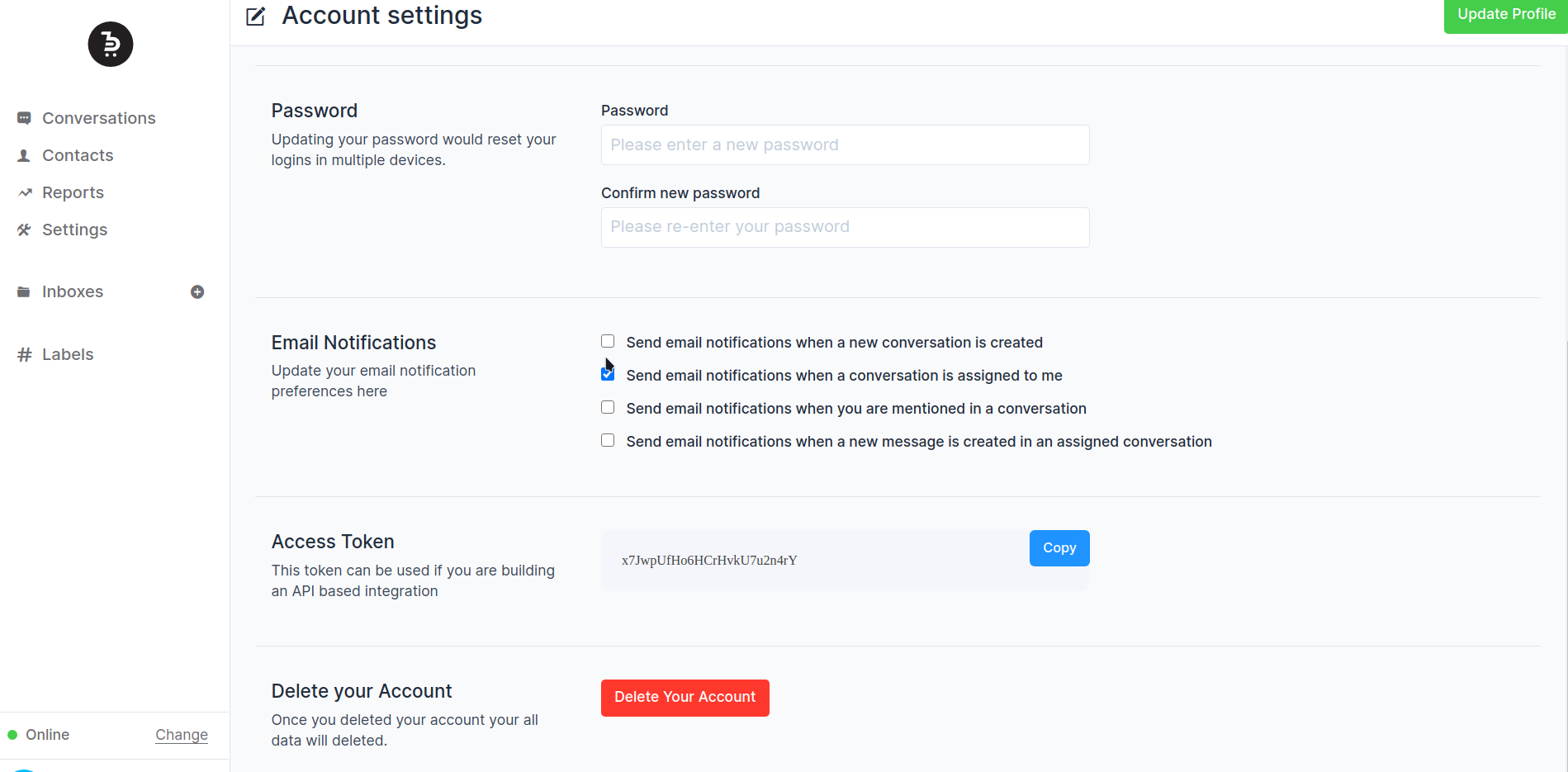
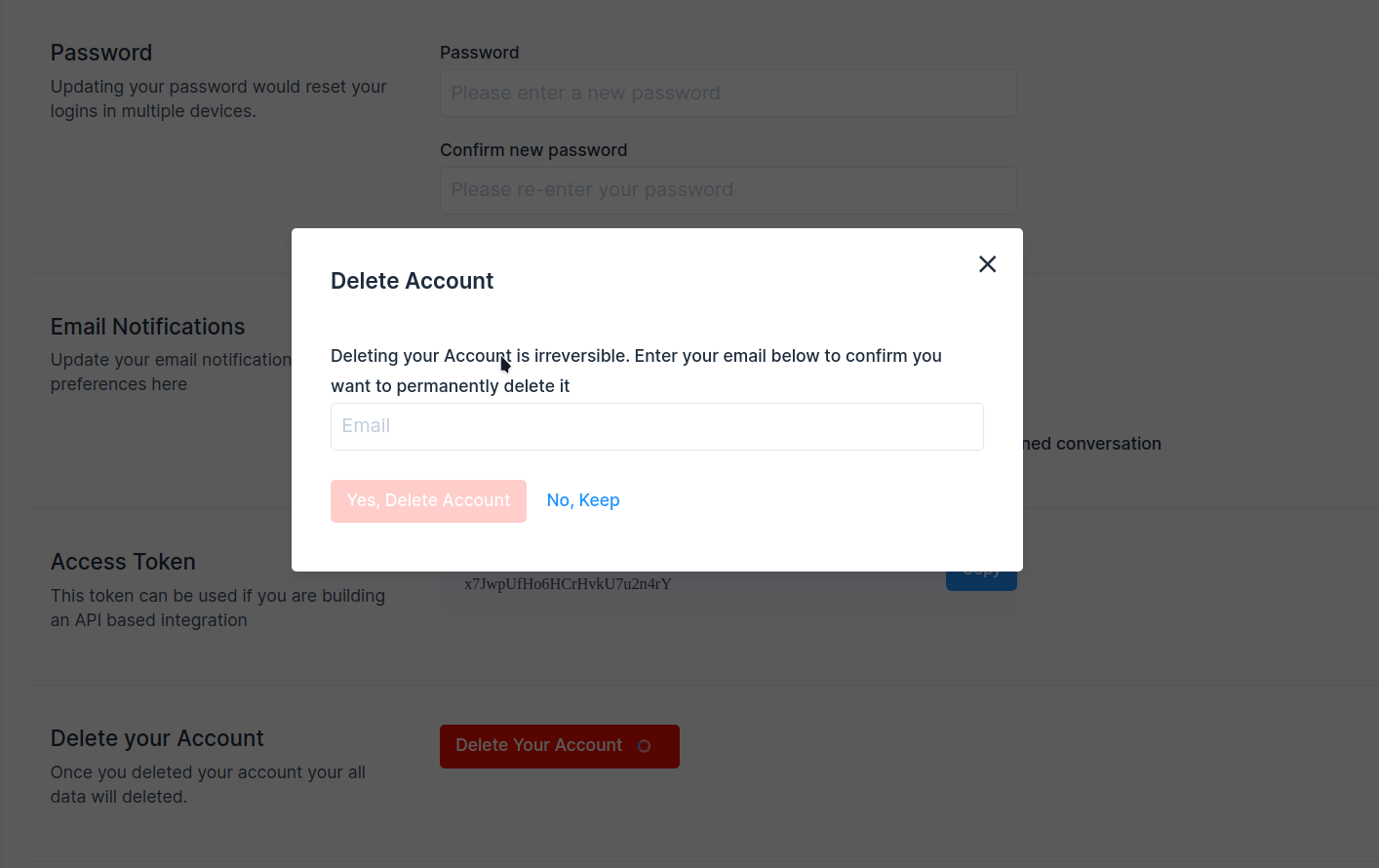
## Description
Add account delete option in the user account settings.
Fixes#1555
## Type of change
- [ ] New feature (non-breaking change which adds functionality)
## Checklist:
- [ ] My code follows the style guidelines of this project
- [ ] I have performed a self-review of my own code
- [ ] I have commented on my code, particularly in hard-to-understand
areas
- [ ] I have made corresponding changes to the documentation
- [ ] My changes generate no new warnings
- [ ] I have added tests that prove my fix is effective or that my
feature works
- [ ] New and existing unit tests pass locally with my changes
- [ ] Any dependent changes have been merged and published in downstream
modules
---------
Co-authored-by: Sojan Jose <sojan@pepalo.com>
Co-authored-by: Sojan Jose <sojan.official@gmail.com>
Co-authored-by: Muhsin Keloth <muhsinkeramam@gmail.com>
# Pull Request Template

## Description

This PR will replace the upgrade banner with an upgrade page view.

## Type of change

- [x] Bug fix (non-breaking change which fixes an issue)

## How Has This Been Tested?

### Loom video

https://www.loom.com/share/0f2b4b09acdd4404bf3211184a470227?sid=7ed60a99-0299-4642-b907-2af8c4dcc643


## Checklist:

- [x] My code follows the style guidelines of this project
- [x] I have performed a self-review of my code
- [x] I have commented on my code, particularly in hard-to-understand
areas
- [ ] I have made corresponding changes to the documentation
- [x] My changes generate no new warnings
- [ ] I have added tests that prove my fix is effective or that my
feature works
- [x] New and existing unit tests pass locally with my changes
- [ ] Any dependent changes have been merged and published in downstream
modules

---------

Co-authored-by: Pranav <pranavrajs@gmail.com>
This PR introduces several improvements to the Captain AI dashboard
section:
- New billing page, with new colors, layout and meters for Captain usage
- Updated the base paywall component to use new colors
- Updated PageLayout.vue, it's more generic and can be used for other
pages as well
- Use flags to toggle empty state and loading state
- Add prop for `featureFlag` to show the paywall slot based on feature
enabled on account
- Update `useAccount` to add a `isCloudFeatureEnabled`
- **Removed feature flag checks from captain route definitions**, so the
captain entry will always be visible on the sidebar
- Add banner to Captain pages for the following cases
- Responses usage is over 80%
- Documents limit is fully exhausted
### Screenshots
<details><summary>Free plan</summary>
<p>


</p>
</details>
<details><summary>Paid plan</summary>
<p>


</p>
</details>
---------
Co-authored-by: Sojan Jose <sojan@pepalo.com>
Co-authored-by: Pranav <pranav@chatwoot.com>
Co-authored-by: Muhsin Keloth <muhsinkeramam@gmail.com>
- Fixed Firecrawl webhook payloads to ensure proper data handling and
delivery.
- Removed unused Robin AI code to improve codebase cleanliness and
maintainability.
- Implement authentication for the Firecrawl endpoint to improve
security. A key is generated to secure the webhook URLs from FireCrawl.

---------

Co-authored-by: Pranav <pranavrajs@gmail.com>
Migration Guide: https://chwt.app/v4/migration

This PR imports all the work related to Captain into the EE codebase. Captain represents the AI-based features in Chatwoot and includes the following key components:

- Assistant: An assistant has a persona, the product it would be trained on. At the moment, the data at which it is trained is from websites. Future integrations on Notion documents, PDF etc. This PR enables connecting an assistant to an inbox. The assistant would run the conversation every time before transferring it to an agent.
- Copilot for Agents: When an agent is supporting a customer, we will be able to offer additional help to lookup some data or fetch information from integrations etc via copilot.
- Conversation FAQ generator: When a conversation is resolved, the Captain integration would identify questions which were not in the knowledge base.
- CRM memory: Learns from the conversations and identifies important information about the contact.

---------

Co-authored-by: Vishnu Narayanan <vishnu@chatwoot.com>
Co-authored-by: Sojan <sojan@pepalo.com>
Co-authored-by: iamsivin <iamsivin@gmail.com>
Co-authored-by: Sivin Varghese <64252451+iamsivin@users.noreply.github.com>
In admin settings, this Pr will add the UI for managing custom roles (
ref: https://github.com/chatwoot/chatwoot/pull/9995 ). It also handles
the routing logic changes to accommodate fine-tuned permissions.

---------

Co-authored-by: Pranav <pranavrajs@gmail.com>
Co-authored-by: Sivin Varghese <64252451+iamsivin@users.noreply.github.com>
Co-authored-by: iamsivin <iamsivin@gmail.com>
Co-authored-by: Muhsin Keloth <muhsinkeramam@gmail.com>
This PR refactors the schema we introduced in #7518 based on the feedback from production tests. Here is the change log

- Decouple Inbox association to a new table inbox_response_sources -> this lets us share the same response source between multiple inboxes
- Add a status field to responses. This ensures that, by default, responses are created in pending status. You can do quality assurance before making them active. In future, this status can be leveraged by the bot to auto-generate response questions from conversations which require a handoff
- Add response_source association to responses and remove hard dependency from response_documents. This lets users write free-form question answers based on conversations, which doesn't necessarily need a response source.
This commit introduces the ability to associate response sources to an inbox, allowing external webpages to be parsed by Chatwoot. The parsed data is converted into embeddings for use with GPT models when managing customer queries.

The implementation relies on the `pgvector` extension for PostgreSQL. Database migrations related to this feature are handled separately by `Features::ResponseBotService`. A future update will integrate these migrations into the default rails migrations, once compatibility with Postgres extensions across all self-hosted installation options is confirmed.

Additionally, a new GitHub action has been added to the CI pipeline to ensure the execution of specs related to this feature.